2075. Decode the Slanted Ciphertext
A string originalText is encoded using a slanted transposition cipher to a string encodedText with the help of a matrix having a fixed number of rows rows.
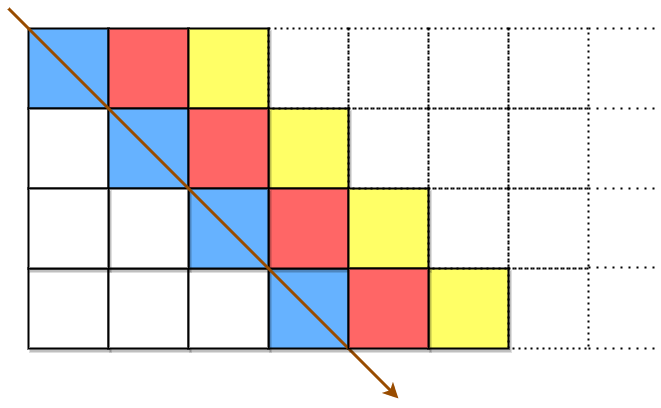
originalText is placed first in a top-left to bottom-right manner.
The blue cells are filled first, followed by the red cells, then the yellow cells, and so on, until we reach the end of originalText. The arrow indicates the order in which the cells are filled. All empty cells are filled with ‘ ‘. The number of columns is chosen such that the rightmost column will not be empty after filling in originalText.
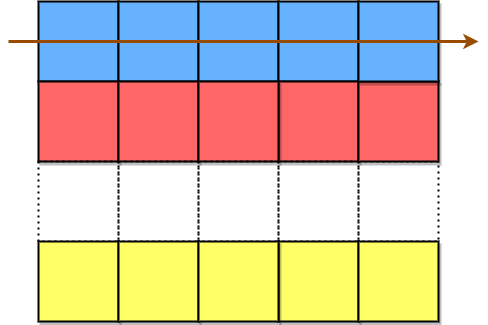
encodedText is then formed by appending all characters of the matrix in a row-wise fashion.
The characters in the blue cells are appended first to encodedText, then the red cells, and so on, and finally the yellow cells. The arrow indicates the order in which the cells are accessed.
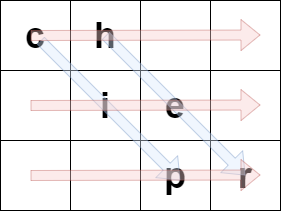
For example, if originalText = “cipher” and rows = 3, then we encode it in the following manner:
The blue arrows depict how originalText is placed in the matrix, and the red arrows denote the order in which encodedText is formed. In the above example, encodedText = “ch ie pr”.
Given the encoded string encodedText and number of rows rows, return the original string originalText.
Note: originalText does not have any trailing spaces ‘ ‘. The test cases are generated such that there is only one possible originalText.
2012. Sum of Beauty in the Array
You are given a 0-indexed integer array nums. For each index i (1 <= i <= nums.length - 2) the beauty of nums[i] equals:
- 2, if nums[j] < nums[i] < nums[k], for all 0 <= j < i and for all i < k <= nums.length - 1.
- 1, if nums[i - 1] < nums[i] < nums[i + 1], and the previous condition is not satisfied.
- 0, if none of the previous conditions holds.
Return the sum of beauty of all nums[i] where 1 <= i <= nums.length - 2.
738. Monotone Increasing Digits
An integer has monotone increasing digits if and only if each pair of adjacent digits x and y satisfy x <= y.
Given an integer n, return the largest number that is less than or equal to n with monotone increasing digits.
742. Closest Leaf in a Binary Tree
Given the root of a binary tree where every node has a unique value and a target integer k, return the value of the nearest leaf node to the target k in the tree.
Nearest to a leaf means the least number of edges traveled on the binary tree to reach any leaf of the tree. Also, a node is called a leaf if it has no children.
In a warehouse, there is a row of barcodes, where the ith barcode is barcodes[i].
Rearrange the barcodes so that no two adjacent barcodes are equal. You may return any answer, and it is guaranteed an answer exists.