Given an integer num, find the closest two integers in absolute difference whose product equals num + 1 or num + 2.
Return the two integers in any order.
1558. Minimum Numbers of Function Calls to Make Target Array
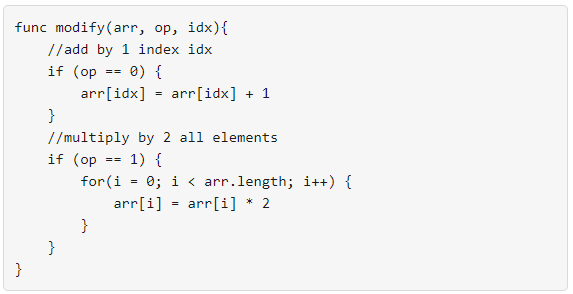
You are given an integer array nums. You have an integer array arr of the same length with all values set to 0 initially. You also have the following modify function:
You want to use the modify function to covert arr to nums using the minimum number of calls.
Return the minimum number of function calls to make nums from arr.
The test cases are generated so that the answer fits in a 32-bit signed integer.
1409. Queries on a Permutation With Key
Given the array queries of positive integers between 1 and m, you have to process all queries[i] (from i=0 to i=queries.length-1) according to the following rules:
- In the beginning, you have the permutation P=[1,2,3,…,m].
- For the current i, find the position of queries[i] in the permutation P (indexing from 0) and then move this at the beginning of the permutation P. Notice that the position of queries[i] in P is the result for queries[i].
Return an array containing the result for the given queries.
1734. Decode XORed Permutation
There is an integer array perm that is a permutation of the first n positive integers, where n is always odd.
It was encoded into another integer array encoded of length n - 1, such that encoded[i] = perm[i] XOR perm[i + 1]. For example, if perm = [1,3,2], then encoded = [2,1].
Given the encoded array, return the original array perm. It is guaranteed that the answer exists and is unique.