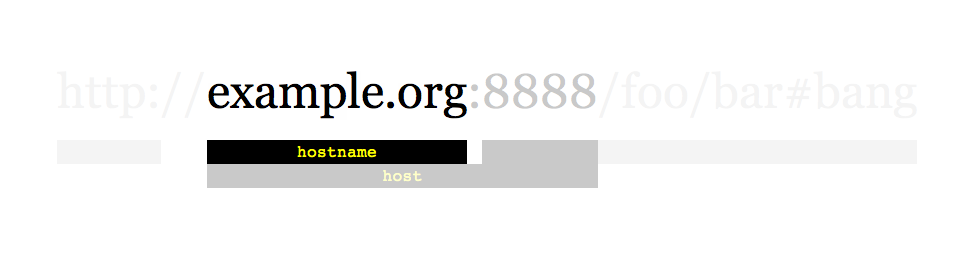
Given a url startUrl and an interface HtmlParser, implement a web crawler to crawl all links that are under the same hostname as startUrl.
Return all urls obtained by your web crawler in any order.
Your crawler should:
- Start from the page: startUrl
- Call HtmlParser.getUrls(url) to get all urls from a webpage of given url.
- Do not crawl the same link twice.
- Explore only the links that are under the same hostname as startUrl.
As shown in the example url above, the hostname is example.org. For simplicity sake, you may assume all urls use http protocol without any port specified. For example, the urls http://leetcode.com/problems and http://leetcode.com/contest are under the same hostname, while urls http://example.org/test and http://example.com/abc are not under the same hostname.
The HtmlParser interface is defined as such:
2
3
4
// Return a list of all urls from a webpage of given url.
public List<String> getUrls(String url);
}Below are two examples explaining the functionality of the problem, for custom testing purposes you’ll have three variables urls, edges and startUrl. Notice that you will only have access to startUrl in your code, while urls and edges are not directly accessible to you in code.
508. Most Frequent Subtree Sum
Given the root of a binary tree, return the most frequent subtree sum. If there is a tie, return all the values with the highest frequency in any order.
The subtree sum of a node is defined as the sum of all the node values formed by the subtree rooted at that node (including the node itself).
1980. Find Unique Binary String
Given an array of strings nums containing n unique binary strings each of length n, return a binary string of length n that does not appear in nums. If there are multiple answers, you may return any of them.
Given the root of a binary tree, return the maximum average value of a subtree of that tree. Answers within 10-5 of the actual answer will be accepted.
A subtree of a tree is any node of that tree plus all its descendants.
The average value of a tree is the sum of its values, divided by the number of nodes.