1772. Sort Features by Popularity
You are given a string array features where features[i] is a single word that represents the name of a feature of the latest product you are working on. You have made a survey where users have reported which features they like. You are given a string array responses, where each responses[i] is a string containing space-separated words.
The popularity of a feature is the number of responses[i] that contain the feature. You want to sort the features in non-increasing order by their popularity. If two features have the same popularity, order them by their original index in features. Notice that one response could contain the same feature multiple times; this feature is only counted once in its popularity.
Return the features in sorted order.
1669. Merge In Between Linked Lists
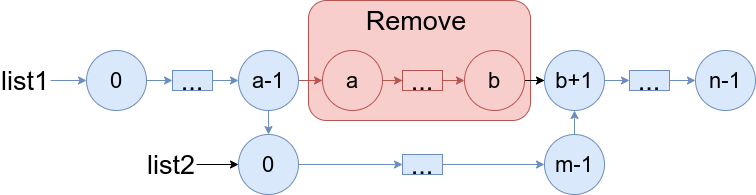
You are given two linked lists: list1 and list2 of sizes n and m respectively.
Remove list1’s nodes from the ath node to the bth node, and put list2 in their place.
The blue edges and nodes in the following figure indicate the result:
Build the result list and return its head.
A kingdom consists of a king, his children, his grandchildren, and so on. Every once in a while, someone in the family dies or a child is born.
The kingdom has a well-defined order of inheritance that consists of the king as the first member. Let’s define the recursive function Successor(x, curOrder), which given a person x and the inheritance order so far, returns who should be the next person after x in the order of inheritance.
2
3
4
5
if x has no children or all of x's children are in curOrder:
if x is the king return null
else return Successor(x's parent, curOrder)
else return x's oldest child who's not in curOrderFor example, assume we have a kingdom that consists of the king, his children Alice and Bob (Alice is older than Bob), and finally Alice’s son Jack.
- In the beginning, curOrder will be [“king”].
- Calling Successor(king, curOrder) will return Alice, so we append to curOrder to get [“king”, “Alice”].
- Calling Successor(Alice, curOrder) will return Jack, so we append to curOrder to get [“king”, “Alice”, “Jack”].
- Calling Successor(Jack, curOrder) will return Bob, so we append to curOrder to get [“king”, “Alice”, “Jack”, “Bob”].
- Calling Successor(Bob, curOrder) will return null. Thus the order of inheritance will be [“king”, “Alice”, “Jack”, “Bob”].
Using the above function, we can always obtain a unique order of inheritance.
Implement the ThroneInheritance class:
- ThroneInheritance(string kingName) Initializes an object of the ThroneInheritance class. The name of the king is given as part of the constructor.
- void birth(string parentName, string childName) Indicates that parentName gave birth to childName.
- void death(string name) Indicates the death of name. The death of the person doesn’t affect the Successor function nor the current inheritance order. You can treat it as just marking the person as dead.
- string[] getInheritanceOrder() Returns a list representing the current order of inheritance excluding dead people.
1375. Number of Times Binary String Is Prefix-Aligned
You have a 1-indexed binary string of length n where all the bits are 0 initially. We will flip all the bits of this binary string (i.e., change them from 0 to 1) one by one. You are given a 1-indexed integer array flips where flips[i] indicates that the bit at index i will be flipped in the ith step.
A binary string is prefix-aligned if, after the ith step, all the bits in the inclusive range [1, i] are ones and all the other bits are zeros.
Return the number of times the binary string is prefix-aligned during the flipping process.
1053. Previous Permutation With One Swap
Given an array of positive integers arr (not necessarily distinct), return the lexicographically largest permutation that is smaller than arr, that can be made with exactly one swap (A swap exchanges the positions of two numbers arr[i] and arr[j]). If it cannot be done, then return the same array.
2307. Check for Contradictions in Equations
You are given a 2D array of strings equations and an array of real numbers values, where equations[i] = [Ai, Bi] and values[i] means that Ai / Bi = values[i].
Determine if there exists a contradiction in the equations. Return true if there is a contradiction, or false otherwise.
Note: When checking if two numbers are equal, check that their absolute difference is less than 10-5.