[LeetCode] Count Number of Special Subsequences

1955. Count Number of Special Subsequences

A sequence is special if it consists of a positive number of 0s, followed by a positive number of 1s, then a positive number of 2s.

  • For example, [0,1,2] and [0,0,1,1,1,2] are special.
  • In contrast, [2,1,0], [1], and [0,1,2,0] are not special.

Given an array nums (consisting of only integers 0, 1, and 2), return the number of different subsequences that are special. Since the answer may be very large, return it modulo 109 + 7.

A subsequence of an array is a sequence that can be derived from the array by deleting some or no elements without changing the order of the remaining elements. Two subsequences are different if the set of indices chosen are different.
Read more
[LeetCode] Check if Move is Legal

1958. Check if Move is Legal

You are given a 0-indexed 8 x 8 grid board, where board[r][c] represents the cell (r, c) on a game board. On the board, free cells are represented by ‘.’, white cells are represented by ‘W’, and black cells are represented by ‘B’.

Each move in this game consists of choosing a free cell and changing it to the color you are playing as (either white or black). However, a move is only legal if, after changing it, the cell becomes the endpoint of a good line (horizontal, vertical, or diagonal).

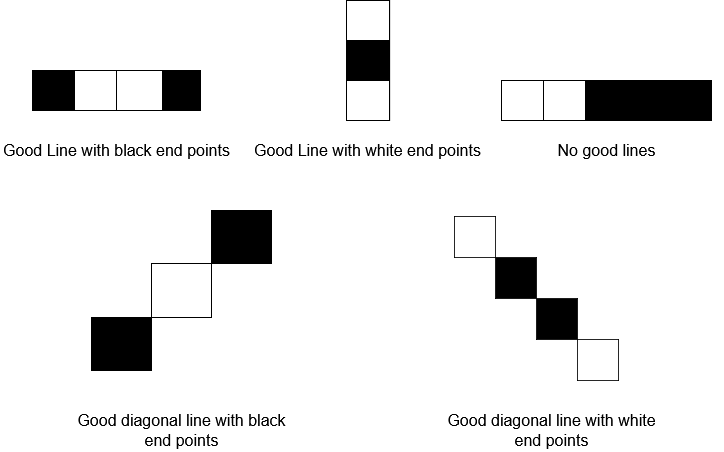
A good line is a line of three or more cells (including the endpoints) where the endpoints of the line are one color, and the remaining cells in the middle are the opposite color (no cells in the line are free). You can find examples for good lines in the figure below:

Given two integers rMove and cMove and a character color representing the color you are playing as (white or black), return true if changing cell (rMove, cMove) to color color is a legal move, or false if it is not legal.

Read more
[LeetCode] Find Missing Observations

2028. Find Missing Observations

You have observations of n + m 6-sided dice rolls with each face numbered from 1 to 6. n of the observations went missing, and you only have the observations of m rolls. Fortunately, you have also calculated the average value of the n + m rolls.

You are given an integer array rolls of length m where rolls[i] is the value of the ith observation. You are also given the two integers mean and n.

Return an array of length n containing the missing observations such that the average value of the n + m rolls is exactly mean. If there are multiple valid answers, return any of them. If no such array exists, return an empty array.

The average value of a set of k numbers is the sum of the numbers divided by k.

Note that mean is an integer, so the sum of the n + m rolls should be divisible by n + m.

Read more
[LeetCode] Maximum Alternating Subarray Sum

2036. Maximum Alternating Subarray Sum

A subarray of a 0-indexed integer array is a contiguous non-empty sequence of elements within an array.

The alternating subarray sum of a subarray that ranges from index i to j (inclusive, 0 <= i <= j < nums.length) is nums[i] - nums[i+1] + nums[i+2] - … +/- nums[j].

Given a 0-indexed integer array nums, return the maximum alternating subarray sum of any subarray of nums.

Read more
[LeetCode] Count Ways to Make Array With Product

1735. Count Ways to Make Array With Product

You are given a 2D integer array, queries. For each queries[i], where queries[i] = [ni, ki], find the number of different ways you can place positive integers into an array of size ni such that the product of the integers is ki. As the number of ways may be too large, the answer to the ith query is the number of ways modulo 109 + 7.

Return an integer array answer where answer.length == queries.length, and answer[i] is the answer to the ith query.

Read more
[AtCoder] E - Ranges on TreeRead more
[AtCoder] D - Strange BallsRead more
[AtCoder] C - Jumping TakahashiRead more
[AtCoder] E - Putting CandiesRead more
[AtCoder] D - Sequence QueryRead more